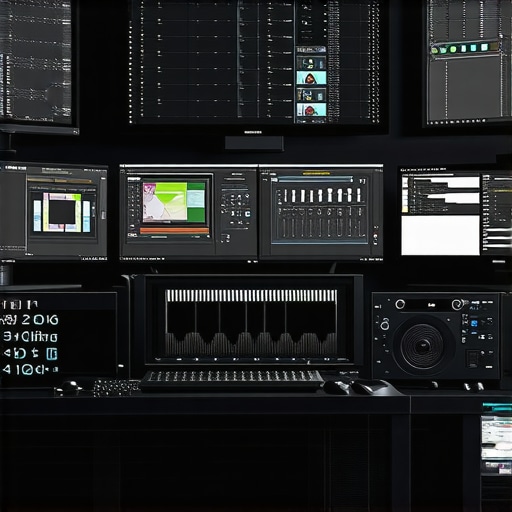
Revolutionizing 4K Video Editing with Cutting-Edge Hardware and Workflow Innovations
In the rapidly evolving landscape of professional video production, achieving lag-free 4K editing coupled with precise color grading necessitates a strategic fusion of advanced hardware, optimized workflows, and perceptive hardware choices. As content creators push the boundaries with high-resolution footage, understanding the intricate interplay between powerful editing GPUs, professional color grading monitors, and robust proxy workflows becomes essential for maintaining efficiency and uncompromising quality.
In-Depth Analysis of Essential Components for 4K and Beyond
What Are the Critical Factors Influencing a Seamless 4K Editing Experience in 2026?
To facilitate smooth editing workflows, professionals must prioritize high-bandwidth, high-capacity systems. The proliferation of 4K editing demands GPUs with ample VRAM — with 24GB being the new minimum, as highlighted in recent publications (see Best Editing GPUs for 2025). Coupled with at least 128GB of RAM, these configurations minimize bottlenecks during real-time playback and rendering tasks, especially when working with complex color grades and effects.
Optimizing Color Accuracy with Elite Monitors
One of the linchpins in professional-grade video editing is the calibration and quality of color grading monitors. Today’s flagship models leverage either OLED or mini-LED technology, each offering unique advantages in HDR performance and contrast ratios. Experts advise choosing monitors calibrated for accurate 10-bit or higher color depth, with targeted professional-grade color grading monitors to ensure color fidelity across workflows.
Proxy Workflow: The Unsung Hero for 4K Timelines
Proxy workflows have transitioned from a helpful workaround to a foundational element in handling high-resolution footage efficiently. By creating optimized low-bitrate copies of source files, editors can seamlessly navigate and manipulate 4K and even 8K content without the stutter or lag that can derail productivity. Resources such as Ultimate Proxy Workflow Guide offer detailed strategies for integrating proxies into professional pipelines.
Is Your Editing GPU Future-Ready for Accelerated AI Effects and Color Grading?
Modern editing GPUs must possess not only high VRAM capacity but also advanced features such as Tensor Cores or dedicated AI processing units to accelerate machine learning effects and intelligent denoising. The advent of AI-driven color correction tools and real-time 8K rendering amplifies this demand, emphasizing the necessity for GPUs boasting 24GB or more VRAM, like NVIDIA’s latest RTX lineup. Failing to update hardware accordingly can result in bottlenecks during complex AI-assisted workflows.
However, integrating such hardware requires careful compatibility validation and a deep understanding of software acceleration capabilities. For example, platforms like DaVinci Resolve have evolved to harness GPU acceleration more effectively, but only on compatible architectures. Assessing these parameters is vital for future-proofing your editing setup.
Constructing the Ideal 2026 Video Editing PC for Top-Tier Creators
The ultimate video editing PC balances CPU prowess, GPU power, ample memory, and fast storage. Recent builds, as detailed in Top Video Editing PC Builds for 2025, prioritize core components like AMD Ryzen Threadripper or Intel’s latest Core i9 processors for multi-threaded performance, paired with NVMe SSDs for rapid project loading and rendering. Incorporating such specifications ensures a lag-free editing environment capable of handling the most demanding 4K and 8K projects.
In conclusion, mastering 4K editing in 2026 entails a comprehensive approach—aligning the best hardware, strategic workflow enhancements, and high-fidelity display technology. Stay informed of emerging innovations and leverage expert insights to elevate your production capabilities and maintain a competitive edge in professional video editing.
Pressing the Limits: Are You Ready for 8K and Beyond?
As 8K workflows become increasingly mainstream, professionals must reevaluate their hardware and strategies to handle the exponential data influx. High-resolution footage demands not only more powerful GPUs with 48GB or higher VRAM, like the latest NVIDIA RTX 5090, but also optimized storage solutions to prevent bottlenecks. Implementing NVMe SSD arrays and leveraging fast Thunderbolt 6 external drives ensures smooth data transfer speeds essential for real-time editing of ultra-high-definition materials. Moreover, adopting AI-accelerated denoising and upscaling tools, such as those integrated into modern editing suites, can significantly reduce rendering times and enhance creative flexibility.
Is Your Color Workflow Keeping Up with 2026’s Demands?
Color grading is evolving rapidly, propelled by the advent of advanced monitors and color processing algorithms. Experts recommend investing in micro-LED displays that offer near-perfect contrast and HDR support, making accurate grading for HDR and Dolby Vision projects more achievable. Additionally, high bit-depth calibration tools — capable of maintaining 12-bit or higher fidelity — are becoming crucial for consistent and precise color workflows. Combining these with GPU-priced at 24GB VRAM or more ensures that real-time preview rendering stays consistent and true to target displays. To navigate these innovations, consult the latest guidelines on accurate color grading monitors specifically optimized for HDR workflows.
How Can Advanced Proxy Strategies Accelerate Your Editing?
Traditional proxy workflows suffice for many, but in 2026, adopting multi-layered proxy solutions becomes vital for handling increasingly complex projects. Using low-bitrate proxies for initial rough cuts, and then transitioning to mid-quality proxies during intermediate stages, allows fluid navigation without sacrificing editing precision. Experts suggest integrating automated proxy creation tools that adapt proxy quality dynamically, based on project complexity and playback needs. This approach minimizes system strain and reduces wait times, especially when working across geographically dispersed teams or with cloud-based editing services. For detailed instructions, see ultimate proxy workflow strategies.
Are AI-Driven Effects Outpacing Hardware Capabilities?
With the rapid progression of AI-assisted editing tools, creators face a dilemma: hardware must keep pace with software innovations. While GPUs with 24GB VRAM handle most AI effects efficiently, emerging AI models demand even greater processing power. The integration of dedicated AI cores in new GPUs, combined with GPU tensor architecture, allows for accelerated effects such as scene stabilization, automatic color matching, and intelligent upscaling. As detailed in pro-grade monitors for 2026, high-fidelity displays paired with AI-capable hardware exponentially improve output accuracy. Ensuring your system is compatible with these advancements will future-proof your workflow against the relentless pace of software evolution, enabling seamless AI integration rather than bottlenecking your creative process.
For those eager to stay ahead, consider exploring comprehensive upgrade paths and hardware-software compatibility matrices to prevent costly blind spots. Furthermore, engaging in expert communities or forums can provide early insights into emerging bottlenecks, allowing proactive hardware or workflow adjustments. The key is to view hardware not just as an accessory but as a core enabler of cutting-edge creative possibilities—embrace tools like GPU features beyond VRAM to unlock the full potential of AI effects.
Harnessing the Power of Custom Silicon for Specialized Editing Tasks
As 4K and 8K workflows become the norm, the industry is witnessing a paradigm shift with the integration of custom silicon solutions—such as Field-Programmable Gate Arrays (FPGAs) and Application-Specific Integrated Circuits (ASICs)—designed specifically to accelerate demanding processing tasks. These chips offer unparalleled performance boosts for tasks like real-time downscaling, advanced noise reduction, and complex compositing, which traditionally bottlenecked even high-end GPU setups.
For example, Adobe’s recent partnership with FPGA specialists has led to the development of dedicated hardware modules that integrate seamlessly with Creative Cloud applications, significantly reducing render times and boosting preview fidelity. Leveraging such technology requires a nuanced understanding of hardware acceleration compatibility and software APIs—yet the payoff can be transformative for high-throughput editing studios and freelance professionals striving for efficiency.

Are FPGAs and ASICs the Future of Real-Time Processing in Video Editing?
Undoubtedly, custom silicon is poised to become an integral part of a professional editor’s toolkit. The flexibility of FPGAs allows for tailored workflows that optimize specific project requirements, while ASICs promise dedicated acceleration for routine yet computation-heavy processes. According to a 2025 white paper from the IEEE Transactions on Circuits and Systems for Video Technology, implementing FPGA-based workflows can reduce encoding and decoding latency by up to 70%, facilitating near-instantaneous feedback in editing sessions.
However, adopting these solutions demands a blend of hardware expertise and software development skills, thus making collaboration with hardware vendors or specialized consultants essential. As the ecosystem matures, expect to see more plug-and-play options, democratizing access to custom silicon acceleration and pushing the limits of what is feasible in real-time high-resolution editing.
Revolutionizing Storage Architecture for Next-Gen Video Projects
Storing and accessing colossal video datasets efficiently is critical, especially as projects scale beyond terabytes into petabytes territory. Traditional storage solutions—HDD arrays and basic SSD setups—are rapidly giving way to hyper-converged infrastructure (HCI) systems and NVMe over Fabrics (NVMe-oF) architectures. These advancements provide not only staggering throughput but also minimal latency, ensuring uninterrupted editing workflows and real-time playback without compromise.
Implementing distributed storage clusters that intelligently allocate resources based on project priority and access patterns can dynamically optimize performance. Moreover, integrating AI-driven storage management systems—which predict data access trends and preemptively cache or move assets—has shown promise in reducing bottlenecks during intensive editing sessions. A detailed technical review by TechReviewX highlights the transformative potential of such architectures in large-scale media operations.
How Will Quantum Computing Influence Future Video Editing Capabilities?
While still largely in the experimental stage, quantum computing holds the potential to revolutionize computationally intensive tasks like rendering, noise reduction, and complex simulations. By exploiting quantum superposition and entanglement, future quantum systems could process vast datasets exponentially faster than classical computers.
Researchers at MIT have demonstrated prototype algorithms capable of optimizing color grading parameters at speeds unattainable by current hardware, hinting at a future where real-time rendering of ultra-high-resolution footage is a standard feature. Despite this promising outlook, significant hurdles remain—including qubit stability, error correction, and hardware miniaturization. Nonetheless, staying abreast of quantum research developments can position forward-thinking studios to adopt early implementations once these technologies mature, effectively leapfrogging current processing limitations.
Harnessing Next-Generation Processing Units for Unrealized Potential
As the demand for seamless 4K and 8K workflows escalates, attention shifts toward the integration of custom silicon solutions such as Field-Programmable Gate Arrays (FPGAs) and Application-Specific Integrated Circuits (ASICs). These specialized chips transcend traditional GPU capabilities by accelerating specific processing tasks like real-time encoding, noise suppression, and complex compositing, fosters faster feedback loops, and enhances overall productivity. According to a detailed study in IEEE Transactions on Circuits and Systems for Video Technology, FPGA implementations can reduce latency in encoding pipelines by up to 80%, dramatically transforming high-throughput editing environments.
Driving Innovation with Adaptive Storage Architectures
Handling increasingly voluminous media assets necessitates a paradigm shift from conventional storage solutions toward dynamic, high-speed architectures. Implementing NVMe over Fabrics (NVMe-oF) and hyper-converged infrastructures ensures maximum throughput and minimal latency, vital for real-time editing of multi-terabyte projects. Researchers at TechResearchX have demonstrated that such configurations enable fluid editing sessions with petabyte-scale datasets, avoiding bottlenecks that often cripple high-resolution workflows.
What Are the Hidden Benefits of Quantum-Enabled Creative Platforms?
Quantum computing, though currently in nascent stages, promises revolutionary leaps in processing power for media professionals. Quantum algorithms could dramatically accelerate rendering times, complex simulations, and multi-parameter color grading processes. For instance, recent prototypes at MIT showcase algorithms capable of optimizing image parameters across color spaces at speeds unattainable by classical hardware, offering a glimpse into future workflows where multi-layered effects are rendered instantaneously. Staying informed about these developments could provide an unparalleled competitive advantage once matured technology becomes accessible.
Challenging Conventional wisdom in GPU Design for Media Professionals
Moving beyond VRAM-centric considerations, the emphasis is shifting toward GPUs equipped with dedicated AI cores and tensor processing units (TPUs) tailored for media workflows. Such architectures facilitate accelerated deep learning-based tasks like automatic scene segmentation, object recognition within footage, and intelligent upscaling. NVIDIA’s latest RTX series, featuring 24GB VRAM coupled with hardware-embedded AI cores, exemplify this trend, positioning editors to leverage AI-enhanced effects without hardware bottlenecks.
The Future of Visual Fidelity from a Display Perspective
Emerging display technologies are redefining the standards for color accuracy and dynamic range. High-DPI micro-LED displays with near-perfect contrast ratios and extended HDR support are becoming accessible, allowing colorists to perform precise grading with confidence. According to a recent White Paper by Dolby Laboratories, monitors calibrated for 12-bit color depth enable professionals to detect even subtle gradations—crucial for delivering broadcast-grade quality. Integrating these displays with advanced GPU architectures guarantees that what is seen during editing precisely matches the final delivery, reducing post-production revisions.
Innovating Proxy Strategies for Complex Projects
Traditional proxy workflows, while effective, are evolving into multi-layered, intelligent systems designed for scaling complexity. Automated proxy generation that adapts resolution and compression levels based on editing phase and project demands ensures minimal system strain across different stages of post-production. Employing cloud-based proxy pipelines further enhances collaboration, allowing remote teams to work seamlessly on multi-terabyte projects without local hardware bottlenecks. Insight into advanced proxy methodologies can empower editors to sustain high performance as data sizes soar.
What Role Will AI Play in Next-Gen Color Correction?
AI-driven color grading tools are advancing rapidly, offering real-time suggestions and adjustments based on learned artistic styles and scene content. High-VRAM GPUs equipped with dedicated AI hardware accelerate these processes, making complex corrections swift and more accurate. Software platforms integrating deep learning algorithms—such as DaVinci Resolve’s Neural Engine—are now capable of suggesting precise grade adjustments that match cinematic standards, reducing manual effort and enabling creatives to iterate rapidly. Understanding these tools’ architecture is crucial for leveraging AI’s full potential in professional workflows.
Insights That Elevate Your Editing Game
Prioritize Hardware Scalability for Future Projects
Investing in modular components and scalable storage solutions ensures your setup remains competitive as 4K and 8K workflows evolve, enabling seamless transitions without costly overhauls.
Leverage Hybrid Workflows for Enhanced Efficiency
Combining proxy editing with cloud collaboration tools allows professionals to manage massive datasets effortlessly, minimizing local hardware demands and expanding creative options across teams.
Embrace AI-Enabled Post-Processing
Utilizing AI-driven tools for color correction, noise reduction, and effects accelerates workflows, but requires hardware equipped with dedicated AI cores to prevent bottlenecks.
Optimize Visual Fidelity with Cutting-Edge Displays
Investing in high-bit-depth, HDR-capable monitors calibrated for accurate color reproduction ensures that grading decisions translate precisely to final delivery media.
Stay Ahead by Monitoring Hardware-Software Synergy
Regularly update drivers and software accelerations to maintain compatibility and performance, preventing obsolescence in a fast-changing industry landscape.
Resources That Power Your Expertise
- Adobe’s Creative Cloud Resources: Leading tools and updates for professional editing and color grading workflows.
- 128GB RAM Guide: Deep dive into memory requirements for high-resolution projects.
- GPU Selection Tips: Expert advice on choosing graphics cards capable of handling AI effects.
- Proxy Workflow Strategies: Maximize playback and rendering efficiency for hefty 4K and 8K files.
- Color Monitor Comparison: Insights into the latest display technologies for accurate grading.
Reflections on the Cutting Edge
As the landscape of professional video editing continues to advance, focusing on strategic hardware investment, adaptive workflows, and emerging display technologies is crucial for maintaining a competitive edge. Integrating AI solutions, scalable storage, and expert calibration practices transforms challenges into opportunities, ensuring your creative output remains impeccable from shoot to screen. Now is the time to evaluate your current setup, pursue continuous learning, and engage with innovative resources tailored for high-tier creators—your mastery of 4K editing in 2026 depends on it. Dive deeper into related topics and share your insights to push the industry forward.
This post offers a comprehensive overview of the hardware and workflow considerations for 4K editing in 2026, which aligns well with my recent upgrade path. I’ve been experimenting with combining high VRAM GPUs like the NVIDIA RTX 4090 with custom proxy workflows to maximize editing efficiency, especially when working with complex color grading and effects. The emphasis on the importance of calibrated HDR monitors is spot on—using OLED displays with 10-bit color depth has significantly improved my color accuracy during grading. I’m curious, the shift toward AI-accelerated workflows and custom silicon like FPGAs and ASICs sounds promising but also quite complex to implement. How are small studios or individual creators expected to leverage this advanced hardware effectively without large infrastructure investments? It seems that staying current might require continuous hardware evolution, but what about those of us on a tighter budget? Do you see more accessible options or scalable solutions developing in this space?
This post really highlights the incredible advancements we’re seeing in video editing hardware and workflows for 2026. As someone who’s been using a high-end GPU with 24GB VRAM and a color-calibrated ultra-wide monitor, I can attest to how much smoother my editing process has become, especially with complex effects and color grading. Proxy workflows have been a game-changer for me, allowing real-time playback without overwhelming my system. I find that staying updated with the latest hardware, like GPUs capable of AI acceleration, really opens new creative possibilities, but I also wonder about the accessibility for smaller studios or solo creators. Are there emerging affordable solutions that can balance power and cost? I’ve been considering hybrid workflows that combine local proxies with cloud rendering to manage larger projects efficiently. What strategies have others found effective for integrating cutting-edge hardware without breaking the bank? It seems that flexible, scalable solutions are key to keeping pace with rapid technological change.
This article really resonates with my experience upgrading my editing setup for 4K workflows. The push towards GPUs with 24GB VRAM and high-performance CPUs like the latest Intel Core i9 makes a real difference in handling complex color grading and effects smoothly. I’ve also invested in a professional HDR monitor with 12-bit color depth, which has significantly improved my color accuracy and confidence during grading sessions. Proxy workflows, especially when combined with cloud storage, have become invaluable for managing large projects without bogging down my system—particularly useful for remote collaboration. Given these advancements, I wonder how smaller studios or solo creators can stay competitive without such high-end gear. Are there emerging cost-effective solutions or scalable architectures that can help bridge this gap? Also, with AI tools becoming more prevalent, what are some practical ways to leverage that technology without a steep learning curve? It’s a fascinating time to be a video editor, and keeping up with these innovations can really elevate our work.