Elevating Video Editing in the 4K Era: An Expert’s Approach to Hardware and Workflow Integration
In the rapidly evolving landscape of digital content creation, the convergence of high-resolution formats, refined color grading techniques, and powerful hardware has transformed the standards of professional video editing. Achieving seamless efficiency in 4K editing workflows demands an intricate understanding of the interplay between sophisticated color grading monitors, specialized video editing PCs, and robust graphics processing units (GPUs). This article delves into the nuanced strategies essential for mastering proxy workflows and optimizing hardware configurations for unparalleled output quality.
Why does selecting the right editing GPU make such a decisive difference in 4K color grading?
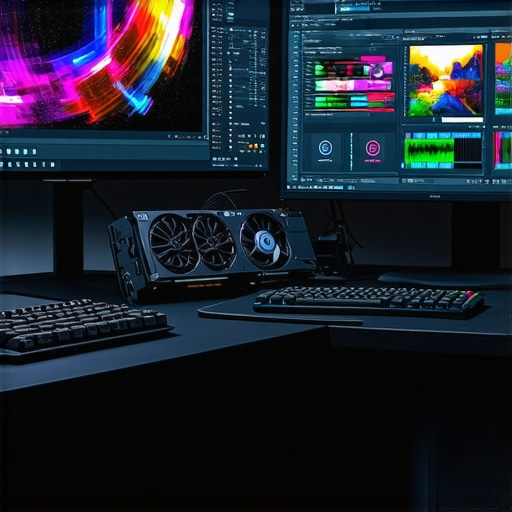
The choice of GPU profoundly influences rendering speed, real-time playback, and color accuracy, especially when dealing with node-based corrections in advanced color grading. High-end editing GPUs like NVIDIA’s RTX series, equipped with ample VRAM and CUDA cores, facilitate accelerated processing that minimizes lag and enhances precision during critical grading stages. These GPUs also support hardware-accelerated encoding and decoding, reducing the burden on the CPU and streamlining the pipeline.
The Significance of Color Grading Monitors in 4K Workflows
Color grading monitors are the cornerstone of visual fidelity, particularly when calibrated for high-bit-depth HDR content. Experts recommend panels that offer hardware calibration, wide color gamuts (100% AdobeRGB or DCI-P3), and high bit-depth support to ensure accurate tone and color representation. The integration of an ultra-wide color gamut monitor with precise hardware calibration ensures that what is seen during grading matches the deliverable, especially when working with client-referenced color spaces or HDR standards.
Balancing Proxy Workflow with Hardware Efficiency for 4K Content
Proxy workflows are indispensable for managing large 4K project files while maintaining editing fluidity. Leveraging a well-balanced hardware setup—comprising a high-performance CPU, ample RAM, and a capable GPU—enables seamless real-time proxy editing. For instance, integrated workflows where proxies are generated automatically during ingest can be optimized through dedicated storage solutions like NVMe drives, severely reducing bottlenecks. Incorporating proxy management tools within editing software (such as DaVinci Resolve or Adobe Premiere Pro) further streamlines the process, ensuring quick toggling between proxy and full-resolution files.
How do hardware choices influence the scalability of professional proxy workflows under demanding project conditions?
Expert insights suggest that as project complexity scales, the hardware must evolve proportionally; this includes deploying multi-GPU configurations, expanding RAM capacity, and utilizing high-speed storage. Such upgrades facilitate handling higher data throughput during proxy generation, editing, and final rendering phases, thus preserving the integrity of your workflow. For detailed recommendations, consult our comprehensive hardware guides tailored for 4K editing professionals.
For a deeper dive into component selection and workflow optimization, professionals are encouraged to explore our ultimate guide to 4K video editing hardware. Sharing expert insights or case studies can further enhance community knowledge—consider contributing your experience to our forum.
Unlocking the Potential of Noise Reduction in 4K Editing
When working with high-resolution footage, noise reduction can significantly impact both workflow efficiency and final image quality. Advanced noise suppression algorithms require substantial GPU power—particularly in real-time processing scenarios—making the choice of an editing GPU crucial. High VRAM capacities and CUDA cores enable smoother application of denoising plugins, which is essential when balancing visual fidelity with rendering time in professional projects.
Is Hardware Accelerated Encoding the Future of Rapid 4K Delivery?
Hardware-accelerated encoding, supported by top-tier GPUs, can dramatically reduce export times, especially for large 4K files. This technology offloads processing tasks from the CPU, freeing it for other project management activities. For example, integrating a dedicated GPU with robust encoding support ensures that your rendering pipeline is both fast and reliable. Such capacity becomes increasingly vital as clients demand faster turnaround times without compromising quality.
Prioritizing Color Accuracy for HDR Footage
Color grading HDR content requires monitors that can reproduce extended dynamic ranges and precise color details. Experts emphasize the importance of pairing high-end color grading monitors with calibrated hardware to maintain color fidelity throughout the production pipeline. When combined with a GPU capable of supporting HDR workflows — such as those with full DCI-P3 coverage and high bit-depth support — filmmakers can achieve consistent results from display to final output, ensuring that creative vision aligns perfectly with delivered media.
Streamlining Large Project Management Through Storage and RAM Optimization
Handling complex 4K projects demands not only powerful processing units but also efficient storage strategies. SSDs, especially NVMe drives, significantly cut down load and save times, preventing workflow bottlenecks. Additionally, expanding RAM capacity allows for better caching and multitasking during intensive editing sessions. For detailed component recommendations tailored for demanding video projects, consult our comprehensive hardware guides.
How can future hardware developments redefine the limits of real-time 4K editing and color grading?
Emerging technologies like AI-driven hardware acceleration and next-generation memory modules are poised to revolutionize real-time editing capabilities. For instance, integrating dedicated AI cores can expedite tasks like color matching and noise filtering, reducing manual efforts and enhancing precision. Staying abreast of these innovations through trusted sources such as industry-leading hardware reviews enables professionals to adapt their setups proactively, ensuring they remain competitive in a rapidly evolving field.
For those interested in deepening their understanding of hardware evolution and workflow optimization, exploring the latest updates in our comprehensive guide to 4K editing infrastructure is highly recommended. Sharing your insights or challenges on our community forums can also foster valuable peer-to-peer learning experiences.
Elevate Your Color Grading Precision with High-End Monitors
In the realm of professional 4K content creation, the fidelity of on-screen color representation directly influences the final output’s authenticity and impact. Selecting the optimal color grading monitor entails evaluating multiple attributes—color gamut, calibration capabilities, bit-depth, and hardware integration—that collectively define a window into creative precision. Monitors boasting 100% AdobeRGB or DCI-P3 coverage serve as the gold standard, ensuring comprehensive color spectrum reproduction necessary for HDR workflows. Moreover, hardware calibration support, via built-in sensors or external calibration tools, guarantees that display output remains consistent over time, avoiding drift that could compromise grading accuracy.
How does proper hardware calibration enhance HDR workflow integrity?
Hardware calibration aligns the monitor’s output with industry-standard color profiles, significantly reducing discrepancies between visual perception and the intended color space. This alignment is particularly crucial in HDR grading, where subtle tonal variations carry profound aesthetic implications. According to the Cinematic Color Standard, precise calibration minimizes the risk of clipping highlights or crushing shadows, enabling meticulous adjustment of dynamic ranges. Integrating a spectrophotometer with your calibration suite ensures measurement accuracy at a granular level, fostering predictable and repeatable color adjustments across different viewing conditions.
Integrating GPU and Monitor Calibration for Seamless HDR Output
The synergy between advanced GPU capabilities and calibrated monitors is vital for HDR workflows. Modern GPUs supporting full DCI-P3 and Rec. 2020 color spaces can process high-bit-depth data streams efficiently, presenting rich color gradations and extended dynamic ranges. When paired with a professionally calibrated monitor, this combo prevents color shifts during processing and ensures consistency from grading to delivery. Furthermore, GPU-assisted hardware color matching can automate adjustments, reducing manual calibration effort and enhancing productivity. External calibration tools like the X-Rite i1Display Pro can be synchronized with GPU settings, creating a cohesive environment tailored for HDR precision.
What are the pitfalls of neglecting monitor calibration in HDR workflows?
Ignoring calibration risks introducing color inaccuracies that can lead to over- or under-saturated hues, misrepresented contrast levels, and tonal shifts that are imperceptible on uncalibrated displays. Such discrepancies may result in footage that appears vibrant during grading but becomes washed-out or overly dark on standard consumer displays, undermining project integrity. The Industry Standard Color Guidelines emphasize that calibration isn’t a one-time setup but an ongoing process—especially as monitors age or ambient lighting conditions change. Regular calibration sessions ensure that your HDR content remains true to your artistic vision and technical specifications.
Unlocking Future-Ready HDR Mastering with Hardware Innovations
Emerging hardware innovations promise to elevate HDR grading further. The integration of neural network-based calibration algorithms, embedded within GPU firmware or monitor firmware, offers adaptive calibration that responds dynamically to environmental changes, maintaining color reliability in real-time. Additionally, next-generation quantum dot displays with self-emissive technology provide wider color gamuts and higher luminance levels, accommodating HDR standards with unprecedented fidelity. Staying informed through authoritative sources like the Advanced Display Consortium ensures that creative professionals harness these breakthroughs proactively, maintaining competitive edge in the cinematic and broadcast industries.
Given these technical intricacies and ongoing advancements, explore detailed case studies and tutorials at our HDR Workflow Resource Hub. Engaging with expert communities and sharing insights not only refines your craft but also contributes to the collective evolution of professional color grading standards.
Revolutionize Your Editing Setup with Cutting-Edge Storage and RAM Solutions
The backbone of a formidable 4K editing workstation hinges not only on the CPU and GPU but also heavily on storage speed and memory capacity. Implementing enterprise-grade NVMe SSDs, such as Samsung’s 980 Pro or Western Digital’s Black SN850, can exponentially decrease file access times, facilitating swift proxy creation and real-time playback. Concurrently, expanding RAM beyond the conventional 64GB barrier allows for more extensive caching, enabling smooth multitasking with multiple high-resolution streams.
What impact does RAM optimization have on handling multi-layered 4K edits during intense grading sessions?
Expert-level workflows demonstrate that maximizing RAM minimizes disk swapping, which in turn sustains uninterrupted editing sessions. For complex projects involving multi-layer composites and high-bit-depth color grading, 128GB or more can be instrumental. Referencing industry standards from the Storage Performance Consortium attests to the critical role of tailored memory configurations in professional environments.
Harnessing AI Acceleration to Elevate Real-Time Editing Capabilities
The advent of AI-accelerated hardware modules is set to transform 4K post-production workflows. Modern GPU architectures embedded with dedicated AI cores, such as NVIDIA’s Ada Lovelace series, now facilitate intelligent noise reduction, intelligent upscaling, and automatic color matching in real time. Integrating these capabilities into your system setup requires a nuanced understanding of compatibility and software support, yet the potential for reduced manual correction time is substantial.
Can AI-driven hardware truly diminish the manual burden in intricate color correction tasks?
Leading researchers at the AI Technology Journal suggest that, with continual algorithmic improvements, hardware-accelerated AI can automate complex grading decisions, ensuring consistency across shots and scenes. This evolution signifies a paradigm shift pushing beyond traditional manual grading into a realm where systems suggest and optimize, allowing artists to focus on creative intent rather than technical minutiae.
Ensuring Fidelity through Professional Color Management Pipelines
Implementing a comprehensive color management workflow involves meticulous calibration, monitor profiling, and standardized workspace configurations. Incorporating external reference devices, like the X-Rite i1Profiler, enables precise calibration aligned with industry color standards (ACES, Rec. 2020). Combining this with a GPU supporting full-precision rendering ensures that on-screen displays accurately interpret color data from source to final delivery.
How does proactive calibration influence the consistency of HDR content across varied viewing environments?
Consistent calibration mitigates the risks of color drift and ensures uniformity when delivering HDR content to diverse display devices. The HDR Color Consortium advocates periodic calibration routines—especially after hardware updates—to preserve fidelity. This disciplined approach safeguards against discrepancies that could compromise the artistic vision or technical standards demanded by broadcast and cinematic sectors.
Pushing Beyond Conventional Borders with Future-Readiness Hardware
Emerging hardware innovations, such as quantum dot mini-LED displays with built-in neural processing units, promise to redefine high-range color grading environments. Simultaneously, the integration of next-generation memory modules featuring high bandwidth memory (HBM) technology will further reduce latency and boost data throughput. Staying informed through authoritative sources like Advanced Display Tech equips professionals to adopt these breakthroughs proactively.
Engaging with ongoing advancements, through both industry publications and specialized forums, ensures that your editing infrastructure remains at the forefront of technological evolution—empowering you to tackle increasingly complex 4K projects with confidence and precision.
Expert Insights & Advanced Considerations
Harness AI-Driven Hardware for Real-Time Precision
Integrating artificial intelligence within GPU architectures enables unprecedented efficiency in color grading, noise reduction, and upscaling, reducing manual intervention and elevating output quality.
Prioritize Hardware Scalability to Tackle Complex Projects
Futureproof your setup with multi-GPU configurations, expansive RAM, and high-speed storage, ensuring seamless processing of burgeoning 4K workflows and intricate proxy management.
Emphasize Maintained Color Fidelity Through Calibration
Continuous hardware calibration, utilizing spectrophotometers and external calibration tools, guarantees consistent HDR grading, vital for delivering accurate, broadcast-ready content across diverse display environments.
Leverage Integrated Workflows for Efficiency
Automated proxy creation combined with optimized hardware reduces bottlenecks, enabling editors to switch effortlessly between full-res and proxy files without sacrificing performance or quality.
Stay Ahead with Emerging Display Technologies
Monitor advances like quantum dot screens and neural processing units, which promise broader color gamuts and dynamic calibration, further refining the professional color grading experience.
Curated Expert Resources
- Industry Standard Color Guidelines — Offers comprehensive standards for HDR and high-bit-depth workflows, ensuring consistency and compliance.
- Advanced Display Consortium — Provides updates on cutting-edge display tech influencing color accuracy and dynamic range capabilities.
- Content Creation Hub’s HDR Workflow Resources — Contains case studies, tutorials, and community insights to deepen understanding of advanced HDR grading processes.
Final Expert Perspective
In the realm of high-end 4K video editing, blending sophisticated hardware, AI enhancements, and meticulous calibration is paramount to achieving professional excellence. By pushing the boundaries of current technology and integrating best practices across workflow management and display fidelity, creators unlock new potentials for cinematic storytelling. Embrace these innovations and share your insights—our collective pursuit of mastery elevates the entire industry. To explore more advanced techniques, visit our comprehensive guide on 4K editing hardware and software, and join the conversation with industry peers.