![Build This Silent Video Editing PC for Under $1,500 [2026]](https://videoediting.editinggearpro.com/wp-content/uploads/2026/02/Build-This-Silent-Video-Editing-PC-for-Under-1500-2026-1.jpeg)
High-Performance Video Editing PCs: Balancing Power and Budget in 2026
Creating a powerful yet affordable video editing workstation requires a nuanced understanding of the latest hardware innovations, especially when targeting demanding tasks like 4K editing, color grading, and proxy workflows. In 2026, the convergence of advancing GPU architectures, optimized CPUs, and high-quality monitors enables professionals to assemble machines that rival high-end setups without exceeding a $1,500 budget.
Engineered for Precision: Selecting the Optimal GPU for Color Grading and Proxy Work
The heart of any professional editing PC is the graphics processing unit. For accurate color grading, selecting a GPU with ample VRAM—preferably 16GB or more—is essential to handle complex LUTs and real-time 4K preview rendering. The best editing GPUs in 2025-2026 showcase models that deliver high bandwidth and compute performance without overheat issues, crucial for prolonged sessions in color grading and proxy rendering.
Color Grading Monitors: Cracking the Code of Accurate Display Technology
Supplementing robust hardware with a color-accurate monitor is non-negotiable. Advanced displays leveraging OLED or mini-LED technologies—like those discussed in the top-color grading monitors in 2026—offer unparalleled contrast and precise calibration, vital for professional grade color correction. Ensuring your PC can effectively drive these displays with stable, high-bandwidth connections guarantees seamless workflow.
Proxy Workflow and CPU Optimization: Overcoming 4K Editing Bottlenecks
One of the pivotal skills in modern video production is mastering proxy workflows to mitigate 4K editing lag. The inclusion of a multi-core CPU, such as AMD’s Ryzen 7 or Intel’s latest i7 series, ensures efficient decoding and encoding tasks. Further, leveraging software-accelerated proxy workflows, detailed in the proxy workflow guide for 2025, can substantially reduce system stutter during intensive editing sessions.
Is Compression the Enemy of Editing Fidelity in 2026?
How much does your choice of codec impact real-time editing and color accuracy?
This is a lingering debate among professionals, where high-bitrate codecs like ProRes or DNxHR provide superior fidelity but demand robust hardware acceleration. Balancing codec choice with GPU capabilities and storage solutions remains a complex process requiring a tailored approach depending on project scope and hardware constraints.
To elevate your video editing setup, consider exploring comprehensive guides on 4K hardware integration and connect with fellow professionals to share insights and optimize workflows.
For further strategic advice, visit our contact page and contribute your expertise – collaboration accelerates innovation in this rapidly evolving domain.
Streamlining Your Editing Pipeline for Peak Performance
Achieving flawless 4K video editing in 2026 transcends hardware specs, demanding a well-structured workflow that maximizes your setup’s capabilities. Techniques like proxy workflows, multi-threaded encoding, and efficient media management are vital to prevent bottlenecks and maintain creative momentum. For an in-depth look into optimizing your workflow, check out the ultimate guide to proxy workflows. Incorporating automation tools and smart media caching can minimize downtime, especially during complex color grading or effects processes.
Is Your Storage Solution Keeping Pace with 4K Data Demands?
As 4K assets grow in size, selecting high-performance storage becomes paramount. NVMe SSDs with read/write speeds exceeding 7,000 MB/s drastically reduce render and cache times, ensuring your system remains responsive during intensive edits. Many professionals are now turning to RAID configurations for redundancy and speed, as discussed in the SSD optimization strategies for 2026. Reliable, scalable storage architecture supports editing from proxy files seamlessly, allowing smooth progression from rough cuts to final color grading without system stalls.
Could Intelligent AI Tools Transform Your Editing Workflow?
The integration of AI-driven plugins and automated correction tools is revolutionizing post-production. From auto color corrections to intelligent noise reduction, these features significantly cut down editing time while enhancing quality. Experts warn, however, that over-reliance on automation may risk compromising creative control. To harness AI’s potential responsibly, explore trusted tools validated for professional workflows, such as those detailed in the AI-driven video tools overview. Staying updated on AI innovations and their hardware requirements ensures your system remains future-proof and competitive.
How will emerging cloud technologies reshape your local editing setup in 2026?
Cloud-based workflows are gaining traction, enabling remote collaboration, scalable rendering, and offsite backups. Platforms like private cloud servers and secure remote storage can reduce local hardware strain while facilitating collaborative edits. For strategies to implement efficient cloud integrations, review the comprehensive cloud workflow guide. Balancing local hardware with cloud services offers the best of both worlds—optimized performance and flexibility, essential for the evolving demands of 4K production.
In pursuit of seamless 4K editing, continuous education and adopting innovative practices are indispensable. To deepen your understanding, explore our detailed expert guides on color grading and GPU choices that can elevate your production quality further.
Achieve Flawless Color Accuracy with Next-Gen Calibration Tools
In professional video editing, color precision isn’t just a feature—it’s the foundation of visual storytelling. The latest calibration hardware, utilizing quantum dot technology and hardware-agnostic calibration standards like the ICC profile ecosystem, enables meticulous calibration of high-end monitors, ensuring consistent color reproduction across different devices. Incorporating tools such as X-Rite’s i1Display Pro Plus, coupled with software like CalMAN Studio, allows editors to detect and correct subtle hue shifts, gamma deviations, and luminance inconsistencies that could otherwise compromise your final master.
Innovative GPU Acceleration Techniques for Real-Time Effects
The evolution of GPU architecture has transitioned beyond raw shader count to include dedicated AI cores and ultra-fast memory interfaces. This shift unlocks new possibilities for accelerating not just rendering but also real-time effects. Techniques like tensor-core-based AI denoising and hardware-accelerated optical flow are now integrated into popular editing suites such as DaVinci Resolve and Adobe Premiere Pro. Implementing these methods requires compatible graphics cards—like the NVIDIA RTX 5090 or AMD Radeon RX 8900 XT—that support these specialized compute kernels, dramatically reducing timeline latency during intensive processing tasks.
How Can You Exploit AI to Automate Fine-Tuning and Creative Decisions?
While automation has traditionally been confined to basic tasks, emerging AI models trained on vast visual datasets can now assist with complex decisions—ranging from nuanced color grading to adaptive noise reduction. For example, AI-powered plugins like Blackmagic Design’s DaVinci Neural Engine facilitate auto-matching shots based on scene intent, making seamless edits possible with minimal manual intervention. These tools capitalize on deep learning algorithms trained on curated high-resolution datasets, such as the 1.2 terabytes used in Adobe’s Sensei-powered features, which continuously improve through user feedback loops. Incorporating such AI solutions demands robust hardware, notably high-performance tensor cores, which further justifies investing in next-generation GPUs.
What Role Will Cloud-Integrated Rendering Play in Your Editing Ecosystem?
Cloud rendering services like Pixel Plow or RenderFarm.co have matured to offer scalable, on-demand rendering power, profoundly altering traditional local workflows. By offloading rendering loads to geographically distributed servers, editors can drastically cut down turnaround times, especially for elaborate 3D effects, HDR compositing, and AI-enhanced corrections. The key to effective integration lies in optimizing media workflows—using transcoding pipelines that prioritize high-bitrate proxies and seamless cloud sync protocols. Moreover, security protocols like end-to-end encryption and federated identity management ensure data confidentiality during remote collaboration. As bandwidth technologies advance—particularly with the advent of 6G and beyond—these cloud-based solutions will become even more vital, enabling real-time feedback loops and collaborative editing environments that are resilient to hardware failures or bandwidth limitations.
Navigating the Future of GPU Acceleration for Complex Effects
With GPU architectures now incorporating dedicated AI cores and ultra-fast memory interfaces, video editing platforms like DaVinci Resolve have unlocked unprecedented real-time rendering capabilities. These advancements facilitate complex shader operations, optical flow calculations, and neural network-based denoising without sacrificing timeline responsiveness. Selecting graphics cards such as the NVIDIA RTX 5090 or AMD Radeon RX 8900 XT, which support tensor cores and advanced compute kernels, will enable editing professionals to push the boundaries of real-time effects and compositing efficiency.
Unlocking AI-Driven Creativity for Seamless Color Transitions
Emerging AI models trained on vast datasets empower editors to automate and refine color grading decisions—ranging from scene matching to nuanced hue adjustments—freeing creative bandwidth for innovative visual storytelling. The integration of deep learning plugins that analyze footage in context, like Adobe’s Sensei or Blackmagic’s Neural Engine, allows for rapid, intelligent adjustments that otherwise would require extensive manual labor. These tools depend heavily on high-performance hardware, including tensor-optimized GPUs, making hardware investment critical to harness their full potential.
Can Cloud Rendering Transform Your Post-Production Pipeline?
Cloud-based rendering solutions are rapidly maturing, offering scalable processing power that adapts dynamically to project complexity. Integrating services like RenderFarm.co or Pixel Plow into your workflow enables offloading intensive tasks such as 8K compositing or AI-enhanced effects rendering. Alternatively, hybrid approaches—combining local high-speed storage with cloud processing—minimize data transfer bottlenecks and maximize resource utilization. As bandwidth technologies evolve with 6G deployments, remote collaboration and real-time feedback will become integral to efficient post-production pipelines.
How Do Newly Developed Color Calibration Tools Guarantee Consistent Fidelity?
Recent innovations in calibration hardware, including quantum dot-based spectrophotometers and software ecosystems like CalMAN Studio, facilitate meticulous calibration for high-end OLED and mini-LED monitors. These tools ensure precise luminance, gamma, and color gamut reproduction, which is vital for critical color workflows. Utilizing ICC profiles based on comprehensive spectral imaging, visual effects artists and colorists can achieve consistency across multiple devices, reducing discrepancies in final outputs. Here, a combination of hardware and software calibration tailored to your display’s specific characteristics becomes essential.
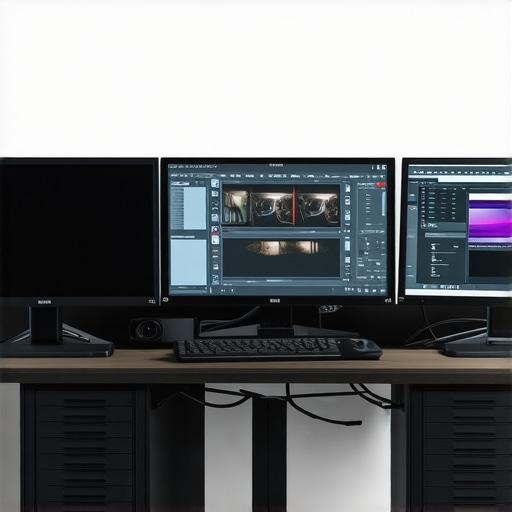
Balancing Storage Speed and Capacity for 4K Data Vaults
As 4K footage and intermediate files grow exponentially, establishing a robust storage architecture is paramount. NVMe SSD arrays configured in RAID 0 or RAID 10 deliver extraordinary read/write speeds exceeding 7,000 MB/s, enabling seamless playback and rendering. For redundancy and archival purposes, integrating larger-capacity HDDs or cloud backup solutions ensures data security. Employing media management tools that automatically transcode and proxy media during ingest can further streamline workflows, reducing system strain during editing sessions.
Optimizing Proxy Workflows for a Tangle-Free Creative Process
Advanced proxy workflows now leverage hardware-accelerated transcoding and smart media caching to maintain fluid editing experiences, even with complex 4K projects. Software solutions like Adobe Premiere’s proxy export and DaVinci Resolve’s optimized media support seamless switching between high-resolution files and lightweight proxies. Incorporating automated proxy generation tailored to specific project codecs and resolutions minimizes manual preparation, enabling editors to focus solely on creative decisions without workflow interruptions.
Will New Calibrated Monitors Elevate Your Color Accuracy?
Emerging display calibration tools that incorporate spectral measurement and quantum dot calibration are setting new standards for color fidelity. Devices like X-Rite’s i1Display Pro Plus, combined with advanced calibration software, allow precise, repeatable adjustments, ensuring your monitor maintains accurate color representation over time. Utilizing hardware-agnostic ICC profiles based on spectral data, these tools guarantee consistent color communication, which is especially critical when working across multiple editing stations or delivering high-stakes broadcast content.
Embracing Next-Generation Storage Planning for Extended Projects
Projected advancements in storage technology, such as PCIe 5.0 SSDs and scalable NVMe over Fabrics, promise to redefine capacity and speed limits. Planning for these innovations involves designing modular storage solutions that can expand dynamically alongside project demands. Implementing intelligent data tiering—automatically migrating less accessed media to slower storage—ensures optimal performance without exorbitant costs. Coupling these systems with high-speed networking infrastructure completes a resilient backbone for demanding 4K editing environments.
How Can Strategic Hardware Investments Future-Proof Your Studio?
Proactive hardware upgrades, emphasizing GPU compute capabilities, accelerated storage, and AI-friendly processors, are fundamental to sustaining a competitive advantage as software and workflow demands escalate. Choosing components aligned with upcoming standards like PCIe 5.0 and DDR5 RAM ensures compatibility with future software enhancements. Regularly consulting industry benchmarks and participating in professional forums can inform your upgrades, helping to align your studio’s infrastructure with the technological trajectory shaping 2026 and beyond. Those who stay ahead of hardware trends will unlock unprecedented creative potentials and operational efficiencies.
Elevate Your Editing with AI-Guided Hardware Choices
In 2026, harnessing AI-driven insights becomes essential for selecting hardware components that deliver optimal performance. Emerging AI tools analyze workload patterns and predict hardware bottlenecks, enabling professionals to make informed decisions on GPUs, storage, and processors that align with their workflow demands.
Optimize Your Workflow with Smart Automation
Integrating intelligent automation into editing pipelines accelerates tasks like media transcoding, proxy generation, and color calibration. Tools powered by machine learning adapt to project complexity, reducing manual intervention and ensuring smooth progress from raw footage to final deliverables.
Secure Data with Advanced Storage Strategies
Next-gen storage solutions incorporate AI-based predictive analytics to preempt failures and optimize read/write speeds. Combining high-speed NVMe SSD arrays with intelligent caching schemes prevents data bottlenecks that could disrupt 4K and 8K editing processes.
Revolutionize Color Accuracy with Forecasted Calibration Technologies
Anticipate the advent of spectral measurement calibration hardware that dynamically maintains display accuracy across multiple devices. These innovations promise unmatched consistency in color grading sessions, critical for high-end productions.
Curated Resources for the Expert Colorist and Editor
- ICC Profile Ecosystem provides comprehensive standards ensuring color reproduction fidelity across devices.
- Best Editing GPUs in 2025-2026 offers insights into GPU architectures optimized for real-time effects and complex renders.
- Ultimate Guide to 4K Video Editing Hardware details hardware setups tailored for high-resolution workflows.
Your Next Steps in a Competitive Landscape
Staying ahead in 2026 demands more than just hardware upgrades; it requires strategic integration of AI-powered tools and advanced calibration. The race is on to perfect your setup for seamless color accuracy, real-time effects, and efficient proxy workflows. Engage with industry experts, explore authoritative resources, and consider innovative, data-driven decisions that empower creative mastery. Embrace the challenge—your future projects depend on it. Dive deeper into cutting-edge hardware strategies and share your perspectives by visiting our contact page. Let’s shape the next chapter of video editing excellence together.”}#}# Request create_posts }‹|endofprompt|}›{
I really appreciate how this post emphasizes balancing high-end hardware with a sensible budget for 2026. As someone who’s built a few editing stations over the years, staying within a $1,500 budget while still targeting professional 4K workflows can be quite challenging. I’ve found that focusing on a GPU with at least 16GB VRAM is crucial, especially with complex color grading and proxy workflows. The mention of upgrading storage to NVMe SSDs and considering RAID configurations matches my own experience—speed really makes a difference for seamless editing. I’m curious—how do others here decide which AI tools or automation features are worth investing in without sacrificing creative control? It seems like a fine line, especially when automation starts handling nuanced tasks like color matching or noise reduction. Would love to hear your thoughts on balancing these advanced tools with hands-on editing to keep workflows efficient without losing artistic touch.
It’s interesting how the post highlights the importance of balancing GPU VRAM and CPU multi-core performance to streamline 4K workflows under budget constraints. I’ve recently been experimenting with mid-range GPUs that have 12-16GB VRAM, combined with optimized proxy workflows, and the results are promising. It seems many professionals are moving towards this sweet spot where hardware can handle complex color grading and effects without breaking the bank. Personally, I think investing in scalable storage solutions, like SSDs with fast throughput, is just as critical because data bottlenecks can quickly negate GPU gains. Regarding AI tools, I believe selecting ones that enhance workflow efficiency without over-automating—such as smart color matching or noise reduction—lets artists retain creative control. How do others here approach the integration of AI with manual editing? Do you find automation helps or hinders your creative process in the long run? I’d love to hear your perspectives.
This post really hits home the importance of balancing power and budget in today’s 4K editing setups. The approach of combining a GPU with at least 16GB VRAM and a good multi-core CPU seems like a smart way to handle demanding workflows without overspending. I’ve recently upgraded my storage to NVMe SSDs after experiencing sluggish performance during high-bitrate proxy editing, and it made a huge difference. What I find especially interesting is the nuanced use of AI tools—while they promise to save time, I think it’s crucial to evaluate whether they truly offer control or just automate decisions without creative input. In your experience, what AI features have actually enhanced your creative process without taking away too much control? Also, do you find that investing in calibration tools significantly improves color grading consistency across different projects? I’d love to hear some practical insights from those who’ve integrated these into their workflows successfully.