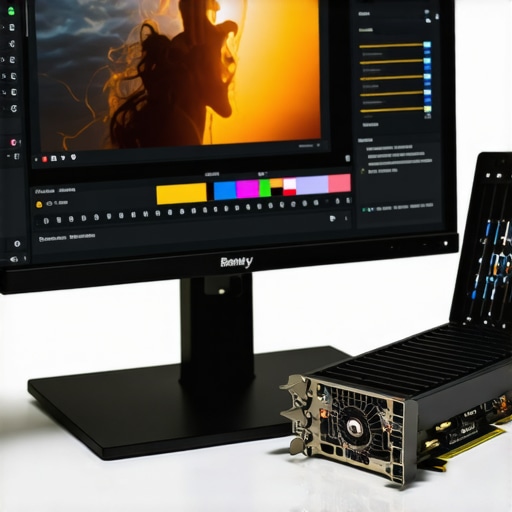
In the rapidly evolving landscape of professional video editing, assembling a high-performance PC tailored for 4K workflows demands a nuanced understanding of hardware synergy. Beyond raw specifications, the integration of potent editing GPUs, meticulously calibrated color grading monitors, and efficient proxy workflows shapes the outcome of cinematic quality and productivity. As industry standards shift towards higher resolutions and complex color management, understanding the intricate interplay of these components becomes essential for experts aiming to push creative boundaries.
Elevating the 4K Editing Experience with a Focused Hardware Strategy
At the core of any advanced video editing setup lies the editing GPU. In 2026, GPUs equipped with 24GB or more VRAM, such as the latest top-tier models for color grading, facilitate seamless rendering and real-time playback of complex effects in 4K projects. These high-capacity GPUs enable accelerated hardware encoding, crucial for proxy workflows that alleviate the strain on primary storage and processing units.
What are the considerations for integrating proxy workflows with high-end GPU setups?
Proxy workflows serve as fundamental tools for managing large 4K files by generating lower-resolution proxies, allowing editors to work swiftly without sacrificing quality during final renders. A well-optimized system leverages GPU acceleration during proxy creation and playback, reducing bottlenecks. Establishing a workflow that synchronizes GPU capabilities with fast NVMe storage and calibrated color grading monitors yields maximum efficiency, especially in collaborative environments or when handling multi-layered compositions.
Choosing Diagnostic Tools for Precise Color Management
Failing to calibrate a monitor can distort color accuracy, undermining professional grading efforts. Modern color grading monitors incorporate automatic calibration features, but expert practitioners often prefer external calibration hardware paired with specialized software for even finer control. Accurate color representation ensures fidelity across devices, critical when grading for HDR standards or matching footage shot with different cameras.
How can calibration protocols impact color consistency across a production pipeline?
Consistent calibration protocols eliminate color shifts introduced by device aging or environmental conditions, thereby maintaining uniformity in deliverables. Regular calibration—at least monthly—and documentation of calibration profiles are practices that seasoned editors follow to uphold color integrity, especially vital in projects where precise color matching is non-negotiable.
Balancing Hardware and Workflow for Future-Proofing
As 4K editing transitions into 8K and beyond, future-proof configurations involve a combination of scalable hardware components and adaptive workflow strategies. Investing in robust GPUs with advanced ray-tracing capabilities, coupled with high-capacity systems optimized for proxy workflows, positions professionals to adapt swiftly to emerging formats. Additionally, cloud integration for collaborative color grading and rendering tasks broadens the scope for scalable resource allocation.
How does the evolution of proxy workflows influence hardware choices in high-end 4K editing systems?
Progressing proxy workflows increasingly depend on GPU acceleration and fast storage solutions. As these workflows become more sophisticated, selecting hardware that supports real-time proxy generation and playback without latency becomes paramount. This trend encourages experts to prioritize GPU VRAM, interface speeds, and optimized software pipelines, ensuring agility in adapting to the demands of future 8K and VR content development.
For a comprehensive understanding of how to tailor PC configurations for 4K color grading and proxy workflows, consider consulting authoritative resources such as the ultimate guide to 4K video editing hardware. Exploring these insights allows professionals to refine their setup for optimal performance, reliability, and creative flexibility.
If you’re aiming to elevate your editing station, reach out to our expert team for tailored hardware consultations or workflow optimization strategies. Sharing your experience can also contribute to a thriving community of high-caliber video professionals committed to pushing the boundaries of digital content creation.
Unlocking the True Potential of Your Color Grading Environment
Beyond selecting a flagship HDR-capable monitor, professionals recognize that consistent environment calibration amplifies color accuracy and reduces grade discrepancies across devices. Employing external calibration hardware combined with software suites like CalMAN or LightSpace ensures that your display maintains true-to-source color fidelity, critically important for HDR workflows and subtler grade distinctions. This meticulous approach to calibration directly influences the efficiency of color decisions, especially when working with high-dynamic-range footage or multi-camera shoots, aligning production outputs with viewers’ expectations and industry standards.
Powerful Graphics Cards as the Backbone of Pro-Level Proxy Creation
In 2026, even the most advanced proxy workflows hinge on GPU capabilities. High-end GPUs with 24GB VRAM or more accelerate proxy generation, rendering, and playback, thus minimizing bottlenecks during editing sessions. The importance of GPU memory speed and bandwidth cannot be understated; faster VRAM and improved memory paths facilitate real-time editing, especially in multi-layer composites with extensive color corrections. Integrating this hardware with optimized software pipelines ensures fluid proxy workflows, empowering editors to seamlessly switch between proxy and high-resolution files without interruptions.
Could cutting-edge GPU architectures redefine proxy workflows in 4K and beyond?
Emerging GPU architectures featuring dedicated AI cores and enhanced tensor operations herald a new era in proxy workflows. These advancements promise accelerated encoding, smarter cache management, and real-time AI-assisted color grading, reducing the dependency on traditional CPU-bound processes. As a result, experts anticipate workflows that are more responsive, precise, and scalable, significantly reducing turnaround times for complex projects. Staying ahead entails not just hardware upgrades but also adopting software that leverages these hardware innovations—making continuous education and adaptation vital for industry leaders.
Enhancing Workflow Resilience with Redundant Storage and Data Integrity Protocols
Ensuring data integrity during high-volume 4K projects requires sophisticated storage solutions. Enterprise-grade NVMe SSDs combined with hardware RAID configurations or software-defined storage mitigate risks of data loss due to hardware failure. Properly implemented, these systems facilitate rapid read/write speeds essential for high-bandwidth proxy files and raw footage, maintaining a smooth editing ecosystem. Regular data verification and error correction protocols further fortify workflows, ensuring that time-consuming rescans or re-edits are minimized, especially in environments where collaboration and remote access are prevalent.
Expert Insight: The Future of Hardware-Driven Adaptive Workflows
As workflows become more adaptive and intelligent, hardware configurations are increasingly integrated with AI-driven management tools. These systems dynamically allocate resources based on project complexity, prioritizing GPU workloads during rendering or color grading, while optimizing CPU and storage I/O in parallel. Understanding this evolving landscape is critical for professionals aiming to future-proof their setups. For in-depth guidance, consult the ultimate guide to hardware integration for 4K workflows. Embracing such insights empowers creators to design flexible, scalable, and resilient editing stations that stand the test of technological advancement.
Thinking about upgrading your hardware for maximum efficiency? Connect with our team today for personalized consultations or share your experiences and tips below to foster a community dedicated to pushing video production boundaries.
Harnessing the Power of AI-Accelerated Rendering in High-End Editing Suites
As 4K workflows evolve, incorporating AI-driven rendering algorithms has transitioned from experimental to essential for professionals aiming to optimize acceleration and image processing quality. Modern GPUs now embed dedicated AI cores capable of executing complex neural network models that significantly reduce rendering times and enhance real-time playback fidelity during color grading sessions. Implementing such hardware necessitates selecting compatible software optimized for AI acceleration, such as DaVinci Resolve Studio’s neural engine or Adobe’s Sensei-powered tools, which intelligently interpret edits and suggest enhancements—streamlining workflows and boosting productivity.
What are the critical hardware considerations for fully leveraging AI-powered rendering?
Integrating AI acceleration demands GPUs with tensor core capabilities, ample VRAM (preferably 32GB or more for 8K workflows), and high-bandwidth memory interfaces. Equally vital is ensuring that the CPU and storage subsystems support high throughput to prevent bottlenecks. Cloud-based AI resources may augment local hardware, enabling distributed processing for large projects. Regular firmware updates and driver optimizations further ensure that hardware advancements translate into practical productivity gains, aligning with industry best practices outlined by NVIDIA’s recent architectural enhancements detailed in NVIDIA’s latest AI GPU architectures.
Designing a Future-Ready Editing Environment with Modular Hardware
The rapid deployment of new formats, codecs, and higher dynamic range standards compels professionals to adopt modular hardware configurations that can adapt without complete overhauls. Multi-node GPU systems, SAN storage arrays, and scalable power supplies configured via intelligent management software enable dynamic resource reallocations based on project demands. This modularity not only future-proofs investments but also allows incremental upgrades—such as transitioning to more efficient AI-enabled GPUs or expanding storage capacity—without disrupting ongoing workflows.
How does modular architecture influence workflow resilience and scalability?
Modular systems allow for gradual scaling, reducing capital expenditure and ensuring compatibility with emerging technologies. Enhanced fault tolerance, achieved through redundant power supplies and hot-swappable components, minimizes downtime during upgrades or maintenance. Furthermore, such flexible setups facilitate collaborative environments, with distributed processing nodes working seamlessly together, thus accelerating rendering, proxy generation, and color grading tasks. According to industry case studies in professional post-production benchmarks, modularity translates directly into operational agility and cost efficiencies, vital for competitive production cycles.
Integrating High-Speed, Low-Latency Network Infrastructure for Remote and Collaborative Editing
In the era of remote production, powerful hardware must be complemented with robust network solutions that support high-speed data transfer and minimal latency. 10GbE or higher Ethernet architectures, coupled with SAN or NAS deployment, enable multiple editors and colorists to access large 4K assets simultaneously, maintaining real-time responsiveness. Advanced network management protocols such as RDMA (Remote Direct Memory Access) and SMB 3.1+ facilitate direct memory access, reducing overhead and latency significantly—permitting collaborative grading and proxy management without workflow interruption.
Can network hardware innovations redefine collaborative workflows in high-resolution video editing?
Absolutely. Emerging protocols like Ethernet AVB and TSN (Time-Sensitive Networking) promise deterministic data transfer, crucial for synchronized playback and editing in distributed environments. By integrating these with high-performance storage and GPU clusters, studios can operate as if they are in a single physical space, even when geographically dispersed. Studies from the journal of multimedia systems emphasize that such infrastructural advancements significantly reduce latency-induced artifacts, leading to more cohesive and efficient collaborative workflows.
For professionals intent on fully leveraging these technological trends, staying abreast of hardware innovations, protocol developments, and industry standards is vital. Engaging with specialized forums, attending industry expos, and consulting with vendors like NVIDIA or Cisco can provide insights tailored to your unique production requirements. Furthermore, integrating adaptive hardware management solutions ensures that your editing environment remains resilient against rapid technological shifts, empowering your creative projects to stay ahead of the curve.
Going Beyond Basics: Crafting an Expert-Level 4K Editing Ecosystem
In the realm of professional 4K video production, merely assembling high-spec hardware no longer suffices. The integration of intelligent workflow strategies, cutting-edge GPU architectures, and adaptive storage solutions forms the bedrock of a truly resilient and efficient post-production environment. Harnessing these elements enhances not only current capabilities but also prepares setups for the surging demands of 8K and immersive VR content.
Synergizing GPU Power with AI-Driven Rendering to Accelerate Creativity
The advent of AI-accelerated rendering introduces a paradigm shift in how high-resolution projects are processed. Modern GPUs equipped with tensor cores, such as NVIDIA’s Ada Lovelace architecture, enable neural network-based upscaling, noise reduction, and real-time AI-assisted grading. These technologies reduce rendering times exponentially and empower artists to experiment with complex effects without workflow bottlenecks. Analyzing the latest benchmarks from authoritative sources such as NVIDIA Developer Blog reveals that AI integration is becoming an indispensable facet of high-end post-production systems.
How can integrating AI capabilities optimize your workflow without sacrificing creative control?
By leveraging AI-driven tools, professionals gain rapid preview generation, intelligent shot matching, and automated corrections that free up valuable creative time. The challenge lies in balancing automation with artistic intent—requiring an understanding of how to fine-tune AI parameters. Implementing comprehensive strategies, including training custom models tailored to specific project styles, can yield uniquely consistent and high-quality outputs, elevating overall productivity and artistic precision.
Dominating Color Fidelity with Modular, High-Precision Calibration Systems
Achieving impeccable color accuracy across diverse display calibrations necessitates modular calibration hardware capable of adaptive profiling. External spectrophotometers, such as those from X-Rite or Klein Instruments, integrated with advanced calibration software like CalMAN Studio or LightSpace, enable continuous fine-tuning aligned with industry standards for HDR and Dolby Vision workflows. This meticulous calibration ensures that color grading remains consistent from initial shoot to final master, especially crucial when collaborating across different geographic locations and display setups.
What steps can you take to maintain visual consistency amid environmental changes and hardware aging?
Implementing a regimented calibration schedule—monthly or bi-weekly—alongside tracking calibration profiles over time ensures stability. Incorporating environmental controls such as controlled lighting and minimized ambient color shifts further stabilizes visual conditions. Using color management workflows aligned with authoritative standards like ITU-R BT.2020 guarantees that your color decisions conform to accepted global industry benchmarks, solidifying your project’s visual integrity.
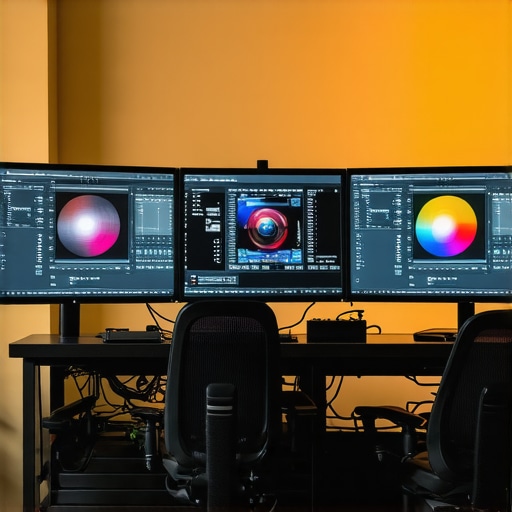
Visual representation of a sophisticated color calibration setup featuring high-precision spectrophotometers and calibrated monitors in a professional color grading suite.
Future-Proofing Through Scalable, Modular Hardware Architectures
Anticipating the rapid evolution of codecs and resolutions requires hardware architectures designed for seamless scalability. Multi-GPU systems interconnected via NVLink or PCIe 5.0 allow for incremental upgrades, accommodating increased processing loads. Similarly, scalable storage arrays employing software-defined solutions ensure rapid data throughput, vital for high-bandwidth proxy workflows and raw footage management. Such modularity safeguards investments against obsolescence, ensuring longevity and adaptability in a fiercely competitive industry.
How does embracing hardware modularity influence your ability to adapt swiftly to emerging standards?
Modular configurations enable incremental investments aligned with project demands, reducing total cost of ownership. They facilitate testing and validation of new components—such as next-generation GPUs or storage protocols—without disrupting existing workflows. According to case studies in industry reports, this flexibility accelerates adoption of innovations like real-time 8K editing and virtual production pipelines, positioning professionals at the forefront of technological advancements.
Optimizing Collaboration via High-Speed, Low-Latency Networking
Scaling high-resolution workflows across distributed teams hinges on cutting-edge network infrastructures. Implementing 100GbE or InfiniBand networks coupled with advanced storage solutions minimizes latency, ensuring real-time editing, proxy management, and color grading across geographically dispersed studios. Protocols like RDMA dramatically reduce data transfer overhead, maintaining synchronization and feedback loops necessary for cohesive project execution.
Can advanced network architectures redefine collaborative excellence in demanding production environments?
Yes, by enabling virtually lag-free collaboration, these infrastructures transform remote workflows from necessity to advantage. They allow multiple users to access shared assets simultaneously with assured consistency, expediting review cycles and refining creative iterations. Emerging standards such as TAA (Time-Aware Applications) and hardware accelerators integrate with these networks to further improve real-time synchronization, as detailed in recent industry whitepapers from multimedia research journals. Staying informed on these developments fosters strategic investments that will keep your workflows competitive and future-ready.
For seasoned professionals, optimizing their 4K editing environment involves more than just selecting the latest components—it requires a nuanced understanding of how hardware synergizes to meet the demands of cutting-edge workflows. Staying ahead means integrating scalable, cutting-edge solutions that handle complex effects, high dynamic range content, and collaborative remote projects seamlessly. Embracing this spirit of innovation ensures you not only match industry standards but push creative boundaries further.
Beyond Hardware Specs: The Art of Strategic Balance
Choosing the perfect GPU isn’t solely about VRAM figures; it’s about leveraging AI-assisted rendering, real-time proxy management, and future-proof architectures. Experts focus on the entire ecosystem—fast NVMe storage, calibrated monitors, and network infrastructure—ensuring each component contributes to a harmonious, efficient pipeline that scales with evolving standards.
How does a holistic approach to hardware selection unlock new creative potentials?
Integrating high-capacity GPUs with adaptive workflow strategies minimizes bottlenecks, enabling real-time playback of sophisticated effects and multi-layer compositions. This synergy empowers editors to experiment freely, knowing their system can handle complex color grading, HDR workflows, and collaborative adjustments without compromise. Continuous education on hardware advancements, such as the latest AI-integrated architectures, remains pivotal for maintaining this edge.
Refining Color Fidelity while Future-Proofing Workflows
Accurate color grading relies on not just high-quality monitors but intelligent calibration protocols that adapt to environmental shifts. External calibration hardware paired with advanced software ensures consistent fidelity, a practice vital for HDR content and multi-camera projects. Simultaneously, scalable modular hardware architectures safeguard investments, providing flexibility for emerging formats like 8K or virtual reality content.
What role does environmental control and calibration consistency play in professional grading?
Maintaining a stable ambient environment and routine calibration protocols are crucial for preventing color shifts that could undermine delicate grading decisions. Experts recommend monthly calibration and employing industry-standard profiles, especially when managing HDR workflows, ensuring your outputs match intended visual experiences across devices and platforms.
Driving Productivity with AI and Modular Hardware Strategies
Advanced GPU architectures with dedicated AI cores revolutionize proxy workflows, making high-resolution editing slightly less daunting. These innovations enable real-time AI-driven upscaling, noise reduction, and shot matching, clipping rendering times significantly. Modular hardware setups—interlinked via NVLink, with scalable storage—ensure your system adapts effortlessly to burgeoning project complexities, securing your competitive edge.
Can embracing AI-driven acceleration redefine high-res workflows for creative professionals?
Absolutely. AI acceleration not only shortens turnaround times but also provides intelligent suggestions for edits and corrections. These tools, when integrated thoughtfully into a flexible, modular setup, foster an environment where experimentation is safe and productivity is maximized—paving the way for innovative storytelling techniques and complex project management.
Stay Ahead with Strategic Resource Management
High bitrate proxy workflows, robust data redundancy, and low-latency networking form the backbone of resilient, high-performance post-production environments. For remote or distributed teams, adopting enterprise-grade networking solutions—like 100GbE or InfiniBand—enables synchronized editing and color grading without perceptible lag. This infrastructure allows collaborative projects to scale effortlessly, aligning with industry-driven demands for efficiency and security.
How does a focus on infrastructure flexibility influence a studio’s ability to adapt to future innovations?
Modular, scalable systems permit incremental upgrades—whether adopting new GPU architectures, expanding storage, or integrating advanced networking protocols—without disrupting ongoing work. This adaptability minimizes costs and maximizes uptime, ensuring your studio remains agile in a fast-changing digital landscape. Continuous engagement with industry standards and emerging technologies—like cloud collaboration platforms—further amplifies this resilience.
For those committed to excellence, exploring comprehensive resources such as the ultimate guide to 4K video editing hardware can provide valuable insights. Connecting with expert teams through professional consultations ensures your setup is tailored for peak performance and future readiness.
Elevate Your Color Grading Environment to Industry Standards
Meticulous calibration is more critical than ever for HDR workflows and multi-camera matching. Combining external spectrophotometers with sophisticated software like CalMAN or LightSpace grants precise control over display fidelity, reducing discrepancies that could compromise artistic intent. Such precision is essential for high-dynamic-range projects destined for cinematic releases or streaming giants that demand industry-leading benchmarks.
High-Performance GPU Innovations Set New Standards
In 2026, GPUs with 24GB VRAM or more are no longer exceptional—they are essential. These high-capacity cards accelerate proxy creation and playback, support complex grading effects, and lay the foundation for real-time 8K workflows. Faster memory speeds, higher bandwidth, and tensor cores specializing in AI workflows unlock new creative horizons, especially in projects integrating real-time ray tracing or volumetric effects.
What new GPU innovations will define the next wave of high-end video editing?
Emerging architectures featuring dedicated AI and ray-tracing cores, coupled with improvements in VRAM and bandwidth, promise to redefine performance standards. Experts in the field anticipate a convergence where AI-assisted editing, real-time rendering, and scalable multi-GPU systems will become standard—making the future of 4K and beyond exceptionally dynamic and creative.
Ensure Data Integrity to Maintain Creative Momentum
Adopting enterprise-grade NVMe storage solutions combined with hardware RAID or software-defined systems guarantees reliable data access and preservation. Regular verification protocols prevent corruption and data loss, critical in high-stakes production environments. Synchronizing these with robust backup strategies ensures your creative process remains uninterrupted, even amidst hardware failures or cyber threats.
Strategic Paths Toward Adaptive and Resilient Workflows
Integrating AI-powered management tools with hardware modularity extends your system’s lifespan and adaptability. From multi-node GPU clusters to scalable storage and intelligent load balancing, these strategies future-proof your studio against technological shifts. As formats evolve and project complexities grow, you will be equipped to pivot swiftly, maintaining competitive professionalism.
Harness Next-Gen Networking for Creative Collaboration
Implementing 100GbE or InfiniBand and leveraging RDMA accelerates remote workflow collaboration, offering near-local performance across dispersed teams. This infrastructure supports multi-user access to large assets, enabling simultaneous editing, grading, and review sessions with minimal latency. This technological backbone transforms traditional workflows into resilient, high-efficiency ecosystems ready for the demands of tomorrow’s high-resolution content creation.
Reimagining What’s Possible in Professional Video Editing
At the intersection of hardware innovation and workflow mastery lies the true potential for creative excellence. Mastering these elements transforms your setup from merely capable to industry-leading, unlocking new dimensions of storytelling. Continuous engagement with authoritative resources, such as top-tier hardware guides and expert consultations, empowers you to stay at the forefront.