Revolutionizing 4K Video Production Through Advanced Hardware and Workflow Optimization
In the realm of professional video editing, particularly within 4K workflows, the confluence of high-fidelity color grading monitors and powerful editing GPUs serves as the backbone for achieving cinematic quality. As industry standards evolve, understanding the nuanced interplay between display technology, GPU acceleration, and streamlined proxy workflows becomes crucial for content creators seeking efficiency without compromising quality.
Precision Display Technologies and Their Impact on Color Fidelity
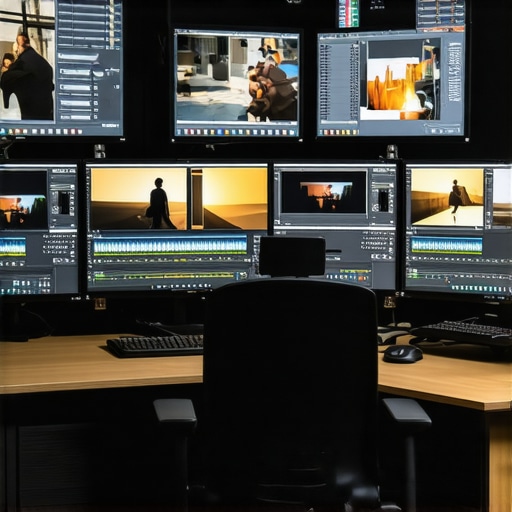
High-end color grading monitors capable of covering wide color gamuts like DCI-P3 or Rec. 2020 enable editors to make accurate color adjustments. Features such as hardware calibration, 10-bit processing, and high dynamic range (HDR) support elevate the visual experience, ensuring that subtle color nuances are preserved across various viewing platforms. When paired with a robust editing GPU, the fidelity of 4K footage is maintained during real-time preview and render, thus reducing post-production iterations.
Selecting the Optimal Editing GPU for 4K Workflows and Proxy Management
The choice of GPU significantly influences rendering speeds and viewport responsiveness. Modern GPUs with ample VRAM, like the NVIDIA RTX series, excel at accelerating decoding and encoding processes—particularly beneficial in proxy workflow scenarios. Efficient proxy workflows, involving lower-resolution substitutes for resource-heavy 4K files, streamline editing on less powerful systems, yet still deliver precise color grading and effects application when the full-resolution files are reintroduced at render time.
Balancing Hardware Capabilities with Workflow Efficiency
Professional editors often face the challenge of balancing raw GPU power against workflow complexities. Implementing hardware-accelerated encoding and decoding, leveraging CUDA or OptiX technologies, can drastically diminish render times. Concurrently, a well-structured proxy workflow enhances throughput, especially in demanding 4K projects. This synergy ensures editors can maintain creative momentum without hardware bottlenecks undermining productivity.
Why Do Some Monitors Severely Limit Color Accuracy and How to Avoid This Pitfall
Many entry-level displays fall short of industry standards, leading to inaccurate color representation that can compromise the grading process. It’s vital to select a monitor with hardware calibration capabilities, extensive color coverage, and consistent gamma response. Such monitors, when correctly calibrated, serve as reliable references, especially when integrated with GPU hardware acceleration for precise color manipulations.
What are the latest innovations in proxy workflows that can further optimize 4K editing sessions?
Emerging technologies like AI-based proxy generation and cloud-based rendering pipelines are transforming traditional editing paradigms, allowing for faster previews and collaboration. These innovations reduce local hardware burden while maintaining high-quality output, representing a significant leap toward seamless 4K production pipelines.
For in-depth strategies on hardware integration, explore the ultimate guide to color grading monitors and editing GPUs. To optimize your workflow further, consider consulting specialized hardware reviews and professional community forums where experts regularly exchange insights. Your investment in cutting-edge display technology and GPU acceleration directly correlates with the quality and efficiency of your 4K video projects, making these choices paramount in today’s competitive production landscape.
Revolutionizing Real-Time Playback and Rendering Efficiency in 4K Editing
Optimizing real-time performance remains a vital goal for professional editors working with 4K footage. Advances in GPU architectures, such as the integration of dedicated ray-tracing cores and AI acceleration units, have transformed rendering pipelines. For instance, leveraging the latest generation of high-performance GPUs enables faster decoding, superior viewport responsiveness, and enhanced effects processing. Additionally, tools like hardware-accelerated encoding with NVENC or AMD’s VCN allow for rapid export times, directly impacting productivity in high-stakes projects.
Unlocking the Power of AI-Driven Proxy Generation and Collaboration Tools
Artificial intelligence has opened new frontiers in proxy workflows, with AI algorithms now capable of automatically generating optimized lower-resolution versions of 4K footage. These smarter proxies facilitate seamless editing even on less capable hardware, reducing lag and improving preview accuracy. Cloud-based collaboration platforms complement this by allowing teams to share and review proxies in real time, facilitating distributed workflows without sacrificing fidelity. Exploring the integration of these innovations can drastically cut down project turnaround times while maintaining high standards of quality. For a comprehensive overview of how AI is reshaping proxy workflows, review the official guide to proxy editing advancements.
Why Do So Many Professionals Delay Hardware Upgrades and How to Break That Cycle
Often, creative professionals hesitate to invest in the latest hardware, assuming incremental benefits do not justify costs. However, this delay can lead to bottlenecks that compromise project timelines and quality. The reality is that modern GPUs with expansive VRAM, native support for AV1 decoding, and compatibility with emerging codecs like VVC enable faster, more efficient workflows. Coupling these with high-refresh-rate, color-accurate monitors optimized for HDR workflows ensures that every frame maintains fidelity from editing through final delivery. Regularly assessing hardware against evolving software demands and project scopes prevents stagnation. To stay current on hardware innovations, consult the latest hardware reviews and expert insights.
Could emerging hardware acceleration techniques redefine the scalability of 4K projects in the next decade?
Emerging technologies like hardware-accelerated ray tracing, compute shader advancements, and quantum computing integration hold promise for exponential improvements in rendering speeds and workflow scalability. As these innovations mature, they may enable real-time rendering of complex effects that traditionally required hours of processing time, fundamentally transforming project timelines and creative possibilities. Embracing these developments early can position professionals at the forefront of the industry, ensuring competitiveness amid rapid technological change.
To deepen your understanding of hardware evolution and its impact on 4K workflows, explore the comprehensive guide to future-proofing your hardware setup. Sharing insights and experiences within professional communities can also reveal innovative strategies for leveraging emerging technologies effectively.
,
Tackling the Bottleneck: Hardware Upgrades as a Strategic Advantage
In the fast-evolving landscape of 4K content creation, the reluctance or delay to upgrade hardware can become a critical stumbling block, limiting creative expression and productivity. Advanced editing workstations equipped with state-of-the-art GPUs and high-speed storage solutions unlock new dimensions of efficiency, enabling editors to handle complex effects, color grading, and proxy workflows seamlessly. Investing proactively in scalable hardware solutions anticipates future software demands, thus avoiding costly bottlenecks during critical project phases.
Harnessing Neural Processing Units: The Frontier of Accelerated Video Processing
The integration of neural processing units (NPUs) into flagship GPUs signals a paradigm shift—bringing dedicated AI acceleration directly into the editing pipeline. These specialized cores facilitate real-time noise reduction, intelligent color matching, and rapid proxy generation, fundamentally transforming traditional workflows. For example, NVIDIA’s Ada Lovelace architecture embeds such capabilities, enabling a more intuitive and accelerated editing experience, minimizing waiting periods and maximizing creative focus.
Can Hardware Make or Break Your Creative Edge in 4K Projects?
Absolutely. The synergy between hardware components—be it GPU, CPU, RAM, or storage—directly affects how swiftly and accurately a professional can realize their vision. Inadequate hardware leads to lag, dropped frames, and sluggish rendering, which can impede creativity and extend project timelines. Conversely, a finely tuned, high-performance hardware setup acts as a catalyst, allowing for real-time previews, high-fidelity color grading, and rapid exports. Recognizing this, many leading studios invest in hardware innovations like PCIe 5.0 NVMe SSDs or multi-GPU configurations to stay ahead.
Nvidia’s Voxel Global Illumination: Does It Promise a New Standard for Real-Time Lighting?
Voxels and ray tracing have revolutionized visual realism in rendering pipelines, but their integration into real-time workflows remains complex. Nvidia’s Voxel Global Illumination (VGI) technology aims to bring authentic, high-quality lighting to live previews, enabling editors to assess effects with unprecedented accuracy. Early benchmarks suggest significant reductions in rendering overhead without compromising visual fidelity, paving the way for hyper-realistic projects executed within editing timelines. For detailed performance analysis, see Nvidia’s recent technical briefing on Voxel GI. To remain competitive, early adoption and hardware compatibility assessment are crucial steps.
Expanding further, understanding how hardware acceleration can be synchronized with evolving software architectures—such as AMD’s FidelityFX or Intel’s XeSS—can offer significant efficiency gains. These technologies leverage machine learning models to upscale lower-resolution previews or accelerate effects processing, again emphasizing the importance of integrating the right hardware for your unique workflow.
Unlocking the Power of Custom Hardware Configurations for Specialized Workflows
Off-the-shelf solutions, while accessible, may not fully meet the rigorous demands of high-end 4K editing. Custom hardware configurations, including tailored motherboards, RAM optimally matched to GPU demands, and SSD arrays configured for maximum throughput, accelerate workflows substantially. For instance, RAID 0 or RAID 10 SSD configurations can dramatically reduce file access times, enabling near-instantaneous playback even with multi-layered effects and high-resolution assets. Venture into custom builds is an investment in long-term efficiency, but it demands a deep understanding of component compatibility and system architecture.
How Do Emerging Memory Technologies Like HBM3 and GDDR7 Reshape Video Editing?
High Bandwidth Memory (HBM3) and next-generation GDDR6X/7 modules promise to significantly boost data transfer rates, alleviating bottlenecks during intensive rendering and playback. Increased memory bandwidth enables smoother workflows with massive files and complex effects, especially in multi-GPU setups or high-resolution timelines. As these technologies become mainstream, early adopters will gain a clear competitive advantage, setting new standards for what is achievable within desktop workstations. To stay informed, professionals should monitor announcements from leading memory manufacturers and evaluate compatibility with current hardware platforms.
Advancing hardware technology is not only about raw speed but also about intelligent system design—balancing components for optimal workflow synergy. It’s advisable to consult with hardware specialists or engage with professional user groups to adapt hardware investments to evolving project complexities and software updates. The future of 4K editing depends on our ability to harness these technological breakthroughs effectively, and proactive planning today ensures seamless scalability tomorrow.
Harnessing High-Performance Display Technologies to Elevate Color Accuracy in 4K Editing
In bridging the gap between visual fidelity and editing precision, cutting-edge display technology plays a pivotal role. Monitors utilizing quantum dot or OLED panels deliver exceptional color reproduction, supporting extensive color gamuts like DCI-P3 and Rec. 2020, essential for professional grading. Integrating hardware calibration tools ensures consistent gamma response and luminance levels, critical for accurate color matching across multiple editing stages. When paired with powerful GPUs capable of real-time 10-bit processing, these displays enable editors to observe minute tonal shifts and nuanced chromatic variations with confidence, significantly reducing post-production revisions and enhancing overall quality.
Optimizing GPU Architectures to Accelerate 4K Workflow and Proxy Handling
Emerging GPU architectures featuring dedicated ray-tracing cores and machine learning accelerators redefine processing efficiency for 4K workflows. Cards like NVIDIA’s RTX 4000 series incorporate tensor cores that facilitate accelerated proxy generation through AI algorithms, drastically reducing the time spent on lower-resolution proxies without sacrificing preview accuracy. This synergy unlocks an unprecedented level of responsiveness, allowing editors to seamlessly toggle between proxy and full-resolution footage during complex effects work. Furthermore, leveraging multi-GPU configurations with high-bandwidth interconnects like NVLink can distribute rendering loads effectively, maintaining real-time playback even in elaborate timelines.

Investigating the Role of Next-Generation Memory Technologies in Handling Massive 4K Data Sets
Recent advancements in memory technology, such as High Bandwidth Memory 3 (HBM3) and GDDR7 modules, promise extraordinary data throughput rates that directly impact editing performance. These technologies enable faster loading of complex assets, smoother timeline scrubbing, and quicker rendering of effects-heavy projects. For instance, the expanded bandwidth reduces bottlenecks during real-time playback of layered 4K sequences, facilitating a more fluid editing experience. As these memory modules mature and become more affordable, systems built with such components will offer scalable performance tailored to the demands of high-resolution content creation, empowering professionals to push the boundaries of visual storytelling.
The Strategic Advantage of Custom Hardware Configurations in 4K Content Production
Custom-tailored hardware solutions—combining high-v ram GPUs, ultra-fast NVMe SSD arrays, and optimized motherboard architectures—serve as a game-changer for intensive 4K editing tasks. Configurations that incorporate multi-GPU setups and PCIe 5.0 interfaces enable unprecedented data transfer rates, reducing project load times and accelerating rendering workflows. Investing in dedicated cooling solutions and power management ensures stability during prolonged processing sessions. Embracing such bespoke system architectures is not merely about raw power but about creating a cohesive environment where each component synergistically furthers creative productivity, thus providing a durable competitive edge in professional video production.
Weighing the Impact of Proprietary Technologies Over Open Standards in Hardware Selection
In the domain of high-end 4K editing, the decision to favor proprietary hardware—like Nvidia’s CUDA ecosystem versus open standards such as Vulkan or DirectX—can influence performance optimization strategies. Proprietary solutions often deliver finely tuned APIs that maximize hardware capabilities, yielding more efficient processing for effects, encoding, and proxy workflows. Conversely, embracing open standards offers broader compatibility and future-proofing but may sometimes result in marginally reduced performance. Evaluating these trade-offs is essential for studios aiming to align their hardware investments with specific software ecosystems, ensuring seamless integration and maximum throughput.
Will Quantum Computing Eventually Reshape the Landscape of 4K Video Processing?
While still in nascent development stages, quantum computing holds the potential to exponentially accelerate computationally intensive tasks like rendering complex effects and simulations in 4K workflows. Theoretically capable of processing vast data sets simultaneously, quantum systems could revolutionize real-time effects rendering, AI-driven proxy generation, and even resolution upscaling. Though practical implementation may still be a decade away, staying informed and preparing infrastructure to integrate such innovations will position forward-thinking studios at the forefront of technological evolution, enabling breakthroughs in visual fidelity and processing speed.
Engaging with emerging research and participating in industry forums focusing on quantum advancements can provide early insights into potential applications. Ultimately, the integration of quantum technologies could redefine operational paradigms, making formerly unthinkable projects achievable within real-time editing environments.
,
Expert Perspectives on Elevating Your 4K Video Workflow
Prioritize Continuous Hardware Innovation to Stay Ahead
Remaining competitive in 4K video production demands persistent hardware upgrades, including high-performance GPUs and advanced memory technologies, to handle increasing data complexity efficiently.
Leverage AI-Driven Proxy Technologies for Seamless Editing
Integrating AI-based proxy generation can drastically reduce editing lag, enabling real-time previews and smoother effects rendering on less powerful systems.
Optimize Color Fidelity with Professional-grade Monitors
Investing in factory-calibrated, wide-gamut displays is essential for accurate color grading, ensuring your content looks exceptional across all viewing platforms.
Implement Scalable Workflow Architectures
Design workflows that incorporate proxy management, GPU acceleration, and cloud collaboration to maximize efficiency and flexibility in high-res projects.
Stay Informed on Emerging Technologies
Keep abreast of innovations like next-generation memory (e.g., GDDR7, HBM3) and hardware-accelerated rendering techniques to future-proof your studio infrastructure.
Authoritative Resources to Deepen Your Expertise
- Ultimate Guide to 4K Video Editing Hardware — Comprehensive insights into hardware setup for optimal performance.
- Top Color Grading Monitors and GPU Tips — Deep dive into display calibration and GPU choices for accurate color work.
- Streamlining Your Video Workflow — Explore advanced proxy workflows leveraging AI and cloud solutions.
- Ultimate Guide to Video Editing PCs and GPUs — Expert recommendations for hardware configurations tailored to 4K projects.
Synthesizing High-Level Insights for Your 4K Projects
Advancing in 4K video production hinges on adopting a holistic approach: integrating evolving hardware capabilities with intelligent workflows, such as AI-powered proxies and scalable systems. Mastery of these elements unlocks new creative potentials while maintaining efficiency. Regularly engaging with authoritative resources and community insights equips you to anticipate industry shifts and implement forward-looking strategies. For ambitious professionals, these insights serve as a compass guiding toward excellence in high-resolution content creation. Dive into these expert avenues to refine your craft and lead in the evolving landscape of 4K video production.